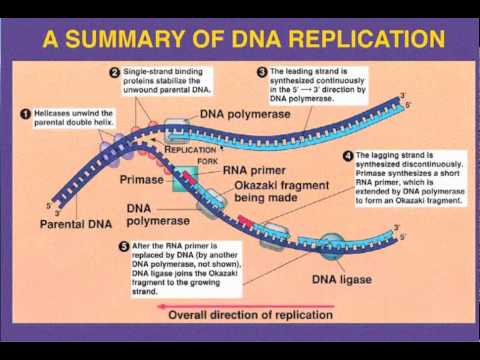
The leading strand is the template strand of the DNA double helix so that the replication fork moves along it in the 3' to 5' direction. This allows the newly synthesized strand complementary to the original strand to be synthesized 5' to 3' in the same direction as the movement of the replication fork.
On the leading strand, a polymerase "reads" the DNA and adds nucleotides to it continuously. This polymerase is DNA polymerase III (DNA Pol III) in prokaryotes and presumably Pol ε in yeasts. In human cells the leading and lagging strands are synthesized by Pol α and Pol δ within the nucleus and Pol γ in the mitochondria. Pol ε can substitute for Pol δ in special circumstances.
Lagging strand
The lagging strand is the strand of the template DNA double helix that is oriented so that the replication fork moves along it in a 5' to 3' manner. Because of its orientation, opposite to the working orientation of DNA polymerase III, which moves on a template in a 3' to 5' manner, replication of the lagging strand is more complicated than that of the leading strand.
On the lagging strand, primase "reads" the DNA and adds RNA to it in short, separated segments. In eukaryotes, primase is intrinsic to Pol α. DNA polymerase III or Pol δ lengthens the primed segments, forming Okazaki fragments. Primer removal in eukaryotes is also performed by Pol δ.[18] In prokaryotes, DNA polymerase I "reads" the fragments, removes the RNA using its flap endonuclease domain (RNA primers are removed by 5'-3' exonuclease activity of polymerase I [weaver, 2005], and replaces the RNA nucleotides with DNA nucleotides (this is necessary because RNA and DNA use slightly different kinds of nucleotides). DNA ligase joins the fragments together.
DNA polymerase is an enzyme that assists in DNA replication. Such enzymes catalyze the polymerization of deoxyribonucleotides alongside a DNA strand, which they "read" and use as a template. The newly-polymerized molecule is complementary to the template strand and identical to the template's partner strand.
DNA polymerase is considered to be a holoenzyme since it requires a magnesium ion as a co-factor to function properly. In the absence of the magnesium ion, it is referred to as an apoenzyme.
DNA-Polymerase initiates DNA replication by binding to a piece of single-stranded DNA.
Function
DNA polymerase can add free nucleotides to only the 3’ end of the newly-forming strand. This results in elongation of the new strand in a 5'-3' direction. No known DNA polymerase is able to begin a new chain (de novo). DNA polymerase can add a nucleotide onto only a preexisting 3'-OH group, and, therefore, needs a primer at which it can add the first nucleotide. Primers consist of RNA and DNA bases with the first two bases always being RNA, and are synthesized by another enzyme called primase. An enzyme known as a helicase is required to unwind DNA from a double-strand structure to a single-strand structure to facilitate replication of each strand consistent with the semiconservative model of DNA replication.
Error correction is a property of some, but not all, DNA polymerases. This process corrects mistakes in newly-synthesized DNA. When an incorrect base pair is recognized, DNA polymerase reverses its direction by one base pair of DNA. The 3'->5' exonuclease activity of the enzyme allows the incorrect base pair to be excised (this activity is known as proofreading). Following base excision, the polymerase can re-insert the correct base and replication can continue.
Variation across species
DNA polymerases have highly-conserved structure, which means that their overall catalytic subunits vary, on a whole, very little from species to species. Conserved structures usually indicate important, irreplicable functions of the cell, the maintenance of which provides evolutionary advantages.
Some viruses also encode special DNA polymerases that may selectively replicate viral DNA through a variety of mechanisms. Retroviruses encode an unusual DNA polymerase called reverse transcriptase, which is an RNA-dependent DNA polymerase (RdDp). It polymerizes DNA from a template of RNA.
DNA polymerase families
Based on sequence homology, DNA polymerases can be further subdivided into seven different families: A, B, C, D, X, Y, and RT.
Family A
Family A polymerases contain both replicative and repair polymerases. Replicative members from this family include the extensively-studied T7 DNA polymerase, as well as the eukaryotic mitochondrial DNA Polymerase γ. Among the repair polymerases are E. coli DNA pol I, Thermus aquaticus pol I, and Bacillus stearothermophilus pol I. These repair polymerases are involved in excision repair and processing of Okazaki fragments generated during lagging strand synthesis.
Family B
Family B polymerases mostly contain replicative polymerases and include the major eukaryotic DNA polymerases α, δ, ε, (see Greek letters used in mathematics) and also DNA polymerase ζ. Family B also includes DNA polymerases encoded by some bacteria and bacteriophages, of which the best-characterized are from T4, Phi29, and RB69 bacteriophages. These enzymes are involved in both leading and lagging strand synthesis. A hallmark of the B family of polymerases is remarkable accuracy during replication; and many have strong 3'-5' exonuclease activity (except DNA polymerase α and ζ, which have no proofreading activity).
Family C
Family C polymerases are the primary bacterial chromosomal replicative enzymes. DNA Polymerase III alpha subunit from E. coli possesses no known nuclease activity. A separate subunit, the epsilon subunit, possesses the 3'-5' exonuclease activity used for editing during chromosomal replication.
Family D
Family D polymerases are still not very well characterized. All known examples are found in the Euryarchaeota subdomain of Archaea and are thought to be replicative polymerases.
Families X
Family X contains the well-known eukaryotic polymerase pol β, as well as other eukaryotic polymerases such as pol σ, pol λ, pol μ, and terminal deoxynucleotidyl transferase (TdT). Pol β is required for short-patch base excision repair, a DNA repair pathway that is essential for repairing abasic sites. Pol λ and Pol μ are involved in non-homologous end-joining, a mechanism for rejoining DNA double-strand breaks. TdT is expressed only in lymphoid tissue, and adds "n nucleotides" to double-strand breaks formed during V(D)J recombination to promote immunological diversity. The yeast Saccharomyces cerevisiae has only one Pol X polymerase, Pol4, which is involved in non-homologous end-joining.
Families Y
The Y-family polymerases differ from others in having a low fidelity on undamaged templates and in their ability to replicate through damaged DNA. Members of this family are hence called translesion synthesis (TLS) polymerases. Depending on the lesion, TLS polymerases can bypass the damage in an error-free or error-prone fashion, the latter resulting in elevated mutagenesis. Xeroderma pigmentosum variant (XPV) patients for instance have mutations in the gene encoding Pol η (eta), which is error-free for UV-lesions. In XPV patients, alternative error-prone polymerases, e.g., Polζ (zeta) (polymerase ζ is a B Family polymerase), are thought to be involved in mistakes that result in the cancer predisposition of these patients. Other members in humans are Pol ι (iota), Pol κ (kappa), and Rev1 (terminal deoxycytidyl transferase). In E.coli, two TLS polymerases, Pol IV (DINB) and PolV (UmuD'2C), are known.
Family RT
The reverse transcriptase family contains examples from both retroviruses and eukaryotic polymerases. The eukaryotic polymerases are usually restricted to telomerases. These polymerases use an RNA template to synthesize the DNA strand.
Prokaryotic DNA polymerases Bacteria have 5 known DNA polymerases:
Pol I: implicated in DNA repair; has both 5'->3'(Polymerase) activity and 3'->5' (Proofreading) exonuclease activity.
Pol II: involved in replication of damaged DNA; has 3'->5' exonuclease activity.
Pol III: the main polymerase in bacteria (elongates in DNA replication); has 3'->5' exonuclease proofreading ability.
Pol IV: a Y-family DNA polymerase.
Pol V: a Y-family DNA polymerase; participates in bypassing DNA damage.
Eukaryotic DNA polymerases Eukaryotes have at least 15 DNA Polymerases:
Pol α (synonyms are DNA primase, RNA polymerase): acts as a primase (synthesizing an RNA primer), and then as a DNA Pol elongating that primer with DNA nucleotides. After around 20 nucleotides elongation is taken over by Pol δ (on the lagging strand) and ε (on the leading strand).
Pol β: Implicated in repairing DNA, in base excision repair and gap-filling synthesis.
Pol γ: Replicates mitochondrial DNA.
Pol δ: Highly processive and has proofreading 3'->5' exonuclease activity. Thought to be the main polymerase involved in lagging strand synthesis, though there is still debate about its role.
Pol ε: Also highly processive and has proofreading 3'->5' exonuclease activity. Highly related to pol δ, and thought to be the main polymerase involved in leading strand synthesis, though there is again still debate about its role.
η, ι, κ, and Rev1 are Y-family DNA polymerases and Pol ζ is a B-family DNA polymerase. These polymerases are involved in the bypass of DNA damage.
There are also other eukaryotic polymerases known, which are not as well characterized: θ, λ, φ, σ, and μ. There are also others, but the nomenclature has become quite jumbled.
None of the eukariotic polymerases can remove primers (5'->3' exonuclease activity); that function is carried out by other enzymes. Only the polymerases that deal with the elongation (γ, δ and ε) have proofreading ability (3'->5' exonuclease). nuclease is a great advocate for DNA replication.
To sequence a piece of dna you need 1)a Template DNA 2) a short DNA primer that is complementary to the dna you want to sequence, 3)A enzyme called DNA polymerase,(4) Four nucleotides.(A,C,G,T), To this mix ,we also add a second type of nucleotide; one that has a slightly different chemical formula, These dideoxynucleotides(diddtp) can be recognized by a DNA sequencer.
To start the sequencing reaction this mixture is heated to 96C ,so the template DNA's two complementary strand separates,Then the temperature is lowered, so that the short "primer" sequence finds its complementary sequence in the template DNA.Finally the temperature is raised 60c,this allows the enzyme to bind to the DNA and create a new strand of DNA.
The sequence of this new DNA is complementary to the original DNA strand. The enzyme makes no distinction between dNTPs or didNTPs.each time a didNTP is incorporated, in this case didATP,The synthesis stops. Because billion of DNA molecules are present in the test tube, the strand can be terminated at any position. This results in collection of DNA strands of many different lengths.
The sequencing reaction is transferred from the test tube to a lane of a polyacrylamide gel. The gel is placed into a DNA sequencer for electrophoresis and analysis. The fragments migrate according to size and each is detected as it passes a laser beam at the bottom of the gel. Each type of dideoxynucleotide emits colored light of a characteristic wavelength and is recorded as a colored band on a simulated gel image, and finally computer program interprets the raw data and outputs an electropherogram with colored peaks representing each letter in the sequence.the sequence fragments are sorted out according to the size, starting from the shortest to longest one, the stimulated gel image is read from bottom to top, starting with the smallest fragment, Thus we sequences present in template DNA.
DNA polymerase is an enzyme that catalyzes the polymerization of deoxyribonucleotides into a DNA strand. DNA polymerases are best-known for their role in DNA replication, in which the polymerase "reads" an intact DNA strand as a template and uses it to synthesize the new strand. The newly-polymerized molecule is complementary to the template strand and identical to the template's original partner strand. DNA polymerases use a magnesium ion for catalytic activity.
Function
DNA polymerase can add free nucleotides to only the 3’ end of the newly-forming strand. This results in elongation of the new strand in a 5'-3' direction. No known DNA polymerase is able to begin a new chain (de novo). DNA polymerase can add a nucleotide onto only a preexisting 3'-OH group, and, therefore, needs a primer at which it can add the first nucleotide. Primers consist of RNA and DNA bases with the first two bases always being RNA, and are synthesized by another enzyme called primase. An enzyme known as a helicase is required to unwind DNA from a double-strand structure to a single-strand structure to facilitate replication of each strand consistent with the semiconservative model of DNA replication.
Error correction is a property of some, but not all, DNA polymerases. This process corrects mistakes in newly-synthesized DNA. When an incorrect base pair is recognized, DNA polymerase reverses its direction by one base pair of DNA. The 3'->5' exonuclease activity of the enzyme allows the incorrect base pair to be excised (this activity is known as proofreading). Following base excision, the polymerase can re-insert the correct base and replication can continue.
Ref:
DNA polymerase. (2009, October 19). In Wikipedia, The Free Encyclopedia. Retrieved 03:55, October 31, 2009, from http://en.wikipedia.org/w/index.php?title=DNA_polymerase&oldid=320725948