Pages

Showing posts with label Insulin. Show all posts

Insulin Signaling Pathway

The insulin transduction pathway is an important biochemical pathway beginning at the cellular level affecting homeostasis. This pathway is also influenced by fed versus fasting states, stress levels, and a variety of other hormones.

When carbohydrates are consumed, digested, and absorbed the pancreas senses the subsequent rise in blood glucose concentration and releases insulin to promote an uptake of glucose from the blood stream. When insulin binds on the cellular insulin receptor, it leads to a cascade of cellular processes that promote the usage or, in some cases, the storage of glucose in the cell. The effects of insulin vary depending on the tissue involved, e.g., insulin is most important in the uptake of glucose by muscle and adipose tissue.

This insulin signal transduction pathway is composed of trigger mechanisms (e.g., autophosphorylation mechanisms) that serve as signals throughout the cell. There is also a counter mechanism in the body to stop the secretion of insulin beyond a certain limit. Namely, those counter-regulatory mechanisms are glucagon and epinephrine. The process of the regulation of blood glucose (also known as glucose homeostasis) also exhibits oscillatory behavior.

On a pathological basis, this topic is crucial to understanding certain disorders in the body such as diabetes (type 1,2,3), hyperglycemia and hypoglycemia.


Insulin signal transduction pathway
The functioning of a signal transduction pathway is based on extra-cellular signaling that in turn creates a response which causes other subsequent responses, hence creating a chain reaction, or cascade. During the course of signaling, the cell uses each response for accomplishing some kind of a purpose along the way. Insulin secretion mechanism is a common example of signal transduction pathway mechanism.

Insulin is produced by the pancreas in a region called Islets of Langerhans. In the islets of Langerhans, there are beta-cells, which are responsible for production of insulin. Insulin is secreted as a response mechanism for counteracting the increasing excess amounts of glucose in the blood.

Glucose in the body increases after food consumption. This is primarily due to carbohydrate intake, but to much lesser degree protein intake ([1])([2]). Depending on the tissue type, the glucose enters the cell through facilitated or passive diffusion. In muscle and adipose tissue, glucose enters through GLUT 4 receptors via facilitated diffusion ([3]). In brain, kidney and retina, glucose enters passively. In the beta-cells of the pancreas, glucose enters through the GLUT 2 receptors (process described below).

Two aspects of this process are explained below: insulin secretion and insulin action on the cell.

Insulin secretion

The glucose that goes in the bloodstream after food consumption also enters the beta cells in the Islets of Langerhans in the pancreas. The glucose passively diffuses in the beta cell through a GLUT-2 vesicle. Inside the beta cell, the following process occurs:

Glucose gets converted to Glucose-6-Phosphate (G6P) through Glucokinase; and G6P is subsequently oxidized to form ATP. This process inhibits the ATP sensitive potassium ion channels of the cell causing the Potassium ion channel to close and not function anymore. The closure of the ATP-sensitive potassium channels causes depolarization of the cell membrane causing the cell membrane to stretch which causes the voltage-gated calcium channel on the membrane to open causing an influx of Ca2+ ions. This influx then stimulates fusion of the insulin vesicles (bubble like structure with insulin in them) to the cell membrane and secretion of insulin in the extracellular fluid outside the beta cell; thus making it enter the bloodstream.

Insulin action on the cell
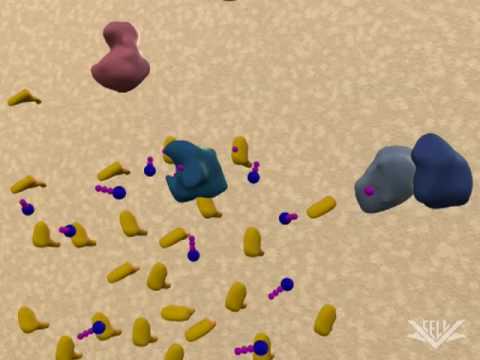
After insulin enters the bloodstream, it is taken up by the cells, as glucose is the preferential fuel for human bodies. However, insulin does not directly go inside the cell in its original form. To activate the effects of insulin, it has to bind to an enzyme that activates its functions. Thus, the insulin binds to the α (alpha) subunit of the insulin receptor embedded in the cell membrane. The α-subunit acts as the insulin receptor and the insulin molecule acts as a ligand in an receptor-ligand complex.

This triggers the tyrosine kinase activity in the β-subunit that is attached to the α-subunit. The tyrosine kinase activity causes phosphorylation (activation) of the enzymes.

The 2 enzymes, Mitogen-activated Protein Kinase (MAP-Kinase) and Phosphatidylinositol-3-Kinase (PI-3K, Phosphoinositide 3-kinase) are responsible for expressing the mitogenic and metabolic actions of Insulin respectively.

The activation of MAP-Kinase leads to completion of mitogenic functions like cell growth and gene expression.

The activation of PI-3K leads to crucial metabolic functions such as synthesis of lipids, proteins and glycogen. It also leads to cell survival and cell proliferation. Most importantly, the PI-3K pathway is responsible for the distribution of glucose for important cell functions. The GLUT-4 vesicle (responsible for passive diffusion of glucose in cell) binds to the PI-3K after bringing glucose in the cell. The PI-3K isolates the GLUT-4 Vesicle from the glucose and sends the vesicle back to the cell membrane. The glucose that is isolated is then sent to the mitochondria to make ATP and excess glucose is stored in the cell as glycogen. [This process is also illustrated in Figure 1.1.2].[2]

Thus, insulin’s role is more of a promoter for the usage of glucose in the cells rather than neutralizing or counteracting it.


Wikipedia contributors. "Insulin signal transduction pathway and regulation of blood glucose." Wikipedia, The Free Encyclopedia. Wikipedia, The Free Encyclopedia, 15 Sep. 2015. Web. 25 Oct. 2015.

Endocrine System Animation

The endocrine system is an integrated system of small organs that involve the release of extracellular signaling molecules known as hormones. The endocrine system is instrumental in regulating metabolism, growth, development and puberty, tissue function, and also plays a part in determining mood.The field of medicine that deals with disorders of endocrine glands is endocrinology, a branch of the wider field of internal medicine.
Function


Bookmark and Share  Subscribe in a reader

The Endocrine system is an information signal system much like the nervous system. However, the nervous system uses nerves to conduct information, whereas the endocrine system mainly uses blood vessels as information channels. Glands located in many regions of the body release into the bloodstream specific chemical messengers called hormones. Hormones regulate the many and varied functions of an organism, e.g., mood, growth and development, tissue function, and metabolism, as well as sending messages and acting on them.

Insulin Resistance


Diabetes Animation

Diabetes mellitus (IPA pronunciation: [ˌdaɪəˈbitəs]). is a metabolic disorder characterized by hyperglycemia (high blood sugar) and other signs, as distinct from a single disease or condition. The World Health Organization recognizes three main forms of diabetes: type 1, type 2, and gestational diabetes (occurring during pregnancy), which have similar signs, symptoms, and consequences, but different causes and population distributions. Type 1 is usually due to autoimmune destruction of the pancreatic beta cells which produce insulin. Type 2 is characterized by tissue-wide insulin resistance and varies widely; it sometimes progresses to loss of beta cell function. Gestational diabetes is similar to type 2 diabetes, in that it involves insulin resistance; the hormones of pregnancy cause insulin resistance in those women genetically predisposed to developing this condition.


Type 1 diabetes mellitus—formerly known as insulin-dependent diabetes (IDDM), childhood diabetes or also known as juvenile diabetes, is characterized by loss of the insulin-producing beta cells of the islets of Langerhans of the pancreas leading to a deficiency of insulin. It should be noted that there is no known preventative measure that can be taken against type 1 diabetes. Most people affected by type 1 diabetes are otherwise healthy and of a healthy weight when onset occurs. Diet and exercise cannot reverse or prevent type 1 diabetes. Sensitivity and responsiveness to insulin are usually normal, especially in the early stages. This type comprises up to 10% of total cases in North America and Europe, though this varies by geographical location. This type of diabetes can affect children or adults but was traditionally termed "juvenile diabetes" because it represents a majority of cases of diabetes affecting children.

The most common cause of beta cell loss leading to type 1 diabetes is autoimmune destruction, accompanied by antibodies directed against insulin and islet cell proteins. The principal treatment of type 1 diabetes, even from the earliest stages, is replacement of insulin. Without insulin, ketosis and diabetic ketoacidosis can develop and coma or death will result.

Currently, type 1 diabetes can be treated only with insulin, with careful monitoring of blood glucose levels using blood testing monitors. Emphasis is also placed on lifestyle adjustments (diet and exercise). Apart from the common subcutaneous injections, it is also possible to deliver insulin by a pump, which allows continuous infusion of insulin 24 hours a day at preset levels and the ability to program doses (a bolus) of insulin as needed at meal times. It is also possible to deliver insulin with an inhaled powder.

Type 1 treatment must be continued indefinitely. Treatment does not impair normal activities, if sufficient awareness, appropriate care, and discipline in testing and medication is taken. The average glucose level for the type 1 patient should be as close to normal (80–120 mg/dl, 4–6 mmol/l) as possible. Some physicians suggest up to 140–150 mg/dl (7-7.5 mmol/l) for those having trouble with lower values, such as frequent hypoglycemic events. Values above 200 mg/dl (10 mmol/l) are often accompanied by discomfort and frequent urination leading to dehydration. Values above 300 mg/dl (15 mmol/l) usually require immediate treatment and may lead to ketoacidosis. Low levels of blood glucose, called hypoglycemia, may lead to seizures or episodes of unconsciousness.

Type 2 diabetes mellitus—previously known as adult-onset diabetes, maturity-onset diabetes, or non-insulin-dependent diabetes mellitus (NIDDM)—is due to a combination of defective insulin secretion and insulin resistance or reduced insulin sensitivity (defective responsiveness of tissues to insulin), which almost certainly involves the insulin receptor in cell membranes. In the early stage the predominant abnormality is reduced insulin sensitivity, characterized by elevated levels of insulin in the blood. At this stage hyperglycemia can be reversed by a variety of measures and medications that improve insulin sensitivity or reduce glucose production by the liver, but as the disease progresses the impairment of insulin secretion worsens, and therapeutic replacement of insulin often becomes necessary. There are numerous theories as to the exact cause and mechanism for this resistance, but central obesity (fat concentrated around the waist in relation to abdominal organs, and not subcutaneous fat, it seems) is known to predispose individuals for insulin resistance, possibly due to its secretion of adipokines (a group of hormones) that impair glucose tolerance. Abdominal fat is especially active hormonally. Obesity is found in approximately 55% of patients diagnosed with type 2 diabetes. Other factors include aging (about 20% of elderly patients are diabetic in North America) and family history (Type 2 is much more common in those with close relatives who have had it), although in the last decade it has increasingly begun to affect children and adolescents, likely in connection with the greatly increased childhood obesity seen in recent decades in some places.

Type 2 diabetes may go unnoticed for years in a patient before diagnosis, as visible symptoms are typically mild or non-existent, without ketoacidotic episodes, and can be sporadic as well. However, severe long-term complications can result from unnoticed type 2 diabetes, including renal failure, vascular disease (including coronary artery disease), vision damage, etc.

Type 2 diabetes is usually first treated by attempts to change physical activity (generally an increase is desired), the diet (generally to decrease carbohydrate intake), and weight loss. These can restore insulin sensitivity, even when the weight loss is modest, for example, around 5 kg (10 to 15 lb), most especially when it is in abdominal fat deposits. Some Type 2 diabetics can achieve satisfactory glucose control, sometimes for years, as a result. However, the underlying tendency to insulin resistance is not lost, and so attention to diet, exercise, and weight loss must continue. The usual next step, if necessary, is treatment with oral antidiabetic drugs. As insulin production is initially unimpaired in Type 2s, oral medication (often used in various combinations) can still be used to improve insulin production (e.g., sulfonylureas), to regulate inappropriate release of glucose by the liver (and attenuate insulin resistance to some extent (e.g., metformin), and to substantially attenuate insulin resistance (e.g., thiazolidinediones). According to one study, overweight patients treated with metformin compared with diet alone, had relative risk reductions of 32% for any diabetes endpoint, 42% for diabetes related death and 36% for all cause mortality and stroke. When oral medications fail (cessation of beta cell insulin secretion is not uncommon amongst Type 2s), insulin therapy will be necessary to maintain normal or near normal glucose levels. A disciplined regimen of blood glucose checks is recommended in most cases, most particularly and necessarily when taking medications.

Beta Cell Antigens and Autoimmune Diseases