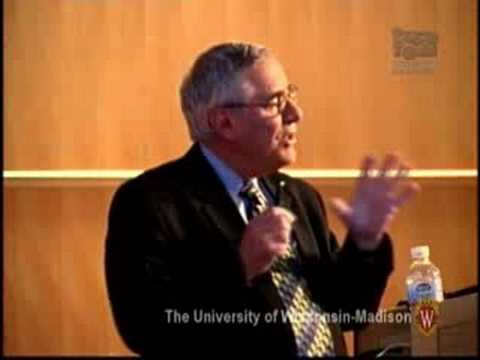
Professor Hector F. DeLuca's laboratory has been devoted to the understanding of metabolism and mechanism of action of vitamins A and D. Sponsored by Wisconsin Academy of Sciences, Arts and Letters in partnership with the Wisconsin Alumni Research Foundation, Dr. DeLuca discusses the fascinating history of the discovery and applications of Vitamin D. Also touched upon is the creation of the Wisconsin Alumni Research Foundation, whose mission is to transform university research into real products that benefit the society at large.
Calcitriol receptor, also known as the Vitamin D receptor (VDR) and also known as NR1I1 (nuclear receptor subfamily 1, group I, member 1), is a member of the steroid hormone receptor family of nuclear receptors. Upon activation by vitamin D, the VDR forms a heterodimer with the retinoid-X receptor and binds to hormone response elements on DNA resulting in expression or transrepression of specific geneproducts.
Glucocorticoids are known to decrease expression of VDR which is expressed in most tissues of the body. Its most well known function is the regulation of intestinal transport of calcium.
This gene encodes the nuclear hormone receptor for vitamin D3. This receptor also functions as a receptor for the secondary bile acid lithocholic acid. The receptor belongs to the family of trans-acting transcriptional regulatory factors and shows sequence similarity to the steroid and thyroid hormone receptors. Downstream targets of this nuclear hormone receptor are principally involved in mineral metabolism though the receptor regulates a variety of other metabolic pathways, such as those involved in the immune response and cancer. Mutations in this gene are associated with type II vitamin D-resistant rickets. A single nucleotide polymorphism in the initiation codon results in an alternate translation start site three codons downstream. Alternative splicing results in multiple transcript variants encoding the same protein