Pages

Showing posts with label prokaryotes animation. Show all posts

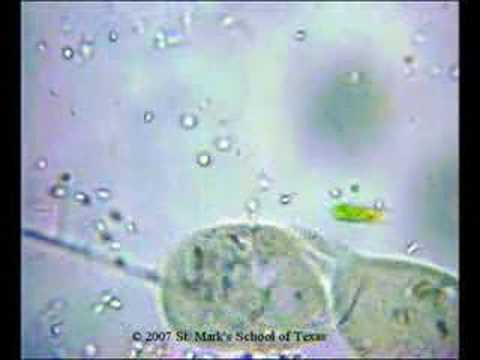
Paramecium Dividing

Paramecia are unicellular organisms usually less than 0.25mm in length and covered with minute hair-like projections called cilia. They are characterized by their cilia which are used in locomotion and during feeding. Paramecia feed on bacteria.


Classification:


Kingdom – Protista
Phylum – Ciliophora
Order – Hymenostomatida
Family -- Paramecidae
Genus – Paramecium
Species – caudatum


Natural Habitat:


Fresh water

Why fresh water?
They take in water by osmosis from the hypotonic environment, bladder-like contractile vacuoles accumulate the excess water from radial canals and periodically expel it through the plasma membrane by contractions of the surrounding cytoplasm.

Interesting characteristics:
Paramecia have 2 nuclei, 1 macronucleus and 1 micronucleus. Some have up to 80 micronuclei!
The organism cannot survive without macronucleus and cannot reproduce without micronucleus.

Reproduction is either by asexual binary fission or occasionally by conjugation (sexual). During binary fission a fully grown organism divides into two daughter cells. Conjugation consists of the temporary union of 2 organisms and the exchange of micronuclear elements. Without the rejuvenating effects of conjugation a paramecium ages and dies. Only opposite mating types, or genetically compatible organisms, can unite in conjugation

Paramecium caudatum in conjugation

Paramecium caudatum are unicellular organisms belonging to the genus of protozoa of the phylum Ciliophora. They are less than 0.25mm in length and covered with minute hair-like projections called cilia. The cilia are used in locomotion and during feeding. They are often called slipper animalcules because of their slipper-like shape.


Paramecium have 2 nuclei (a large macronucleus and a single compact micronucleus). They cannot survive without macro-nucleus and cannot reproduce without micro-nucleus. Reproduction is either by asexual binary fission or occasionally by conjugation (sexual) and rarely by endomixis, a process involving total nuclear reorganization of individual organisms. During binary fission a fully grown organism divides into two daughter cells. Conjugation consists of the temporary union of 2 organisms and the exchange of micro-nuclear elements. Without the rejuvenating effects of conjugation a paramecium ages and dies. Only opposite mating types, or genetically compatible organisms, can unite in conjugation.

Hydra feeding

Hydra is a genus of simple, fresh-water animals possessing radial symmetry. Hydras are predatory animals belonging to the phylum Cnidaria and the class Hydrozoa. They can be found in most unpolluted freshwater ponds, lakes and streams in the temperate and tropical regions by gently sweeping a collecting net through weedy areas. They are usually a few milimeters long and are best studied with a microscope. Biologists are especially interested in hydras due to their regenerative ability. Hydras appear to be unique among animals in that they do not undergo senescence (aging).


When feeding, hydras extend their body to maximum length and then slowly extend their tentacles. Despite their simple construction, the tentacles of hydras are extraordinarily extensible and can be four to five times the length of the body. Once fully extended, the tentacles are slowly maneuvered around waiting for contact with a suitable prey animal. Upon contact, nematocysts on the tentacle fire into the prey and the tentacle itself coils around the prey. Within 30 seconds most of the remaining tentacles will have already joined in the attack to subdue the struggling prey. Within two minutes, the tentacles will have surrounded the prey and moved it into the opened mouth aperture. Within ten minutes, the prey will have been enclosed within the gastrovascular cavity and digestion will have started. The hydra is able to stretch its body wall considerably in order to digest prey more than twice its size. After two or three days, the undigestible remains of the prey will be discharged by contractions through the mouth aperture.

The feeding behaviour of the hydra demonstrates the sophistication of what appears to be a simple nervous system.

Daphnia Heart Beat

Daphnia are small, mostly planktonic, crustaceans, between 0.2 and 5 mm in length. Daphnia are members of the order Cladocera, and are one of the several small aquatic crustaceans commonly called water fleas because of their saltatory swimming style (although fleas are insects and thus only very distantly related). They live in various aquatic environments ranging from acidic swamps to freshwater lakes, ponds, streams and rivers.


Even under relatively low power, it is possible to observe the feeding mechanism working, watch immature young moving in the brood-pouch, observe the eye being moved by the ciliary muscles and even watch blood corpuscles being pumped round the circulatory system by the simple heart. The heart is at the top of the back, just behind the head, and their average heart rate is approximately 180bpm under normal conditions. Daphnia, like many animals, are prone to alcohol intoxication, and make excellent subjects for studying the effects of the depressant on the nervous system – due to the translucent exoskeleton, and the visibly altered heart rate. They are tolerant of being observed live under a cover slip and appear to suffer no harm when returned to open water. This experiment can also be done using caffeine, nicotine or adrenaline and observing an increase in heart rate.

Vorticella Feeding

Vorticella is a genus of protozoa, with over 100 known species. They are stalked inverted bell-shaped ciliates, placed among the peritrichs. Each cell has a separate stalk anchored onto the substrate, which contains a contracile fibril called a myoneme. When stimulated this shortens, causing the stalk to coil like a spring. Reproduction is by budding, where the cell undergoes longitudinal fission and only one daughter keeps the stalk. Other genera such as Carchesium resemble Vorticella but are branched or colonial.


Some of the most common species include:
  • Vorticella campanula
  • Vorticella citrina
  • Vorticella communis
  • Vorticella convallaria
  • Vorticella floridensis
  • Vorticella limnetis
  • Vorticella marina
  • Vorticella microstoma
  • Vorticella monilata
  • Vorticella patellina
  • Vorticella similis
  • Vorticella smaragdina
  • Vorticella sphaerica
  • Vorticella striata
  • Vorticella submicrostoma
  • Vorticella utriculus

Amoeba Feeds

Amoeba (sometimes amœba or ameba, plural amoebae) is a genus of protozoa that moves by means of pseudopods, and is well-known as a representative unicellular organism. The word amoeba or ameba is variously used to refer to it and its close relatives, now grouped as the Amoebozoa, or to all protozoa that move using ,pseudopods, otherwise termed amoeboids. The amoeba was first discovered by August Johann Rösel von Rosenhof in 1755. Early naturalists referred to Amoeba as the Proteus animalcule after the Greek god Proteus who could change his shape. The name "amibe" was given to it by Bery St. Vincent, from the Greek amoibè, meaning change.


Feeding


  1. Amoeba extends pseudopodia in vicinity of food.
  2. Pseudopodia surround prey.
  3. Prey is now completely engulfed in a Food Vacuole.
  4. Food vacuole moves towards the rear end (uroid) of the amoeba.
  5. Water is extracted from the Food Vacuole and digestive enzymes are added.
  6. Finally, the undigested material is ejected at the cell surface.


Amoeba itself is found in decaying vegetation in fresh and salt water, wet soil, and animals. Due to the ease with which they may be obtained and kept alive, they are common objects of study as representative protozoa and to demonstrate cell structure and function.