Somatic cell nuclear transfer (SCNT) is a laboratory technique for creating an ovum with a donor nucleus . It can be used in embryonic stem cell research, or in regenerative medicine where it is sometimes referred to as "therapeutic cloning." It can also be used as the first step in the process of reproductive cloning.
In SCNT the nucleus, which contains the organism's DNA, of a somatic cell (a body cell other than a sperm or egg cell) is removed and the rest of the cell discarded. At the same time, the nucleus of an egg cell is removed. The nucleus of the somatic cell is then inserted into the enucleated egg cell. After being inserted into the egg, the somatic cell nucleus is reprogrammed by the host cell. The egg, now containing the nucleus of a somatic cell, is stimulated with a shock and will begin to divide. After many mitotic divisions in culture, this single cell forms a blastocyst (an early stage embryo with about 100 cells) with almost identical DNA to the original organism.
Process SCNT in stem cell research
Some researchers use SCNT in stem cell research. The aim of carrying out this procedure is to obtain stem cells that are genetically matched to the donor organism. Presently, no human stem cell lines have been derived from SCNT research.
Human Embryonic Stem cell colony on mouse embryonic fibroblast feeder layer.
A potential use of genetically-customized stem cells would be to create cell lines that have genes linked to the particular disease. For example, if a person with Parkinson's disease donated his or her somatic cells, then the stem cells resulting SCNT would have genes that contribute to Parkinson's disease. In this scenario, the disease-specific stem cell lines would be studied in order to better understand the disease.
In another scenario, genetically-customized stem cell lines would be generated for cell-based therapies to transplant to the patient. The resulting cells would be genetically identical to the somatic cell donor, thus avoiding any complications from immune system rejection.
Only a handful of the labs in the world are currently using SCNT techniques in human stem cell research. In the United States, scientists at the Harvard University Stem Cell Institute, the University of California San Francisco, and possibly Advanced Cell Technology are currently researching a technique to use somatic cell nuclear transfer to produce embryonic stem cells. In the United Kingdom, the Human Fertilisation and Embryology Authority has granted permission to research groups at the Roslin Institute and the Newcastle Centre for Life. SCNT may also be occurring in China.
In 2005, a South Korean research team led by Professor Hwang Woo-suk, published claims to have derived stem cell lines via SCNT, but supported those claims with fabricated data.Recent evidence has proved that he in fact created a stem cell line from a parthenote.
SCNT in reproductive cloning
This technique is currently the basis for cloning animals (such as the famous Dolly the sheep), and in theory could be used to clone humans. However, most researchers believe that in the foreseeable future it will not be possible to use this technique to produce a human clone that will develop to term.
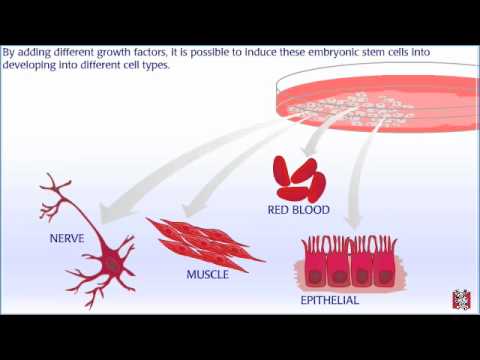
Embryonic stem cells are derived from blastocysts — embryos that are about a week old. At this stage, the blastocyst has about 100 cells. Human blastocysts like this have been donated to research from in vitro fertilization clinics. In order to get embryonic stem cell lines, scientists remove cells from the inner cell mass region. These cells have the potential to develop into any type of cell in the body. Once the cells are removed, they are placed on a culture plate with nutrients and growth factors. The blastocyst is destroyed in this process. An embryonic cell line is established when these cells multiply and divide. Under the right conditions, these cell lines can be maintained indefinitely. By adding different growth factors, it is possible to induce these embryonic stem cells into developing into different cell types. These cells could someday be used in therapies to replace damaged cells and organs.
Induced pluripotent stem cells, commonly abbreviated as iPS cells or iPSCs are a type of pluripotent stem cell artificially derived from a non-pluripotent cell, typically an adult somatic cell, by inducing a "forced" expression of specific genes.
Induced Pluripotent Stem Cells are similar to natural pluripotent stem cells, such as embryonic stem (ES) cells, in many respects, such as the expression of certain stem cell genes and proteins, chromatin methylation patterns, doubling time, embryoid body formation, teratoma formation, viable chimera formation, and potency and differentiability, but the full extent of their relation to natural pluripotent stem cells is still being assessed.
iPSCs were first produced in 2006 from mouse cells and in 2007 from human cells. This has been cited as an important advance in stem cell research, as it may allow researchers to obtain pluripotent stem cells, which are important in research and potentially have therapeutic uses, without the controversial use of embryos. They may also be less prone to immune rejection than embryonic stem cells because of the fact that they are derived entirely from the patient.
Depending on the methods used, reprogramming of adult cells to obtain iPSCs may pose significant risks that could limit its use in humans. For example, if viruses are used to genomically alter the cells, the expression of cancer-causing genes or oncogenes may potentially be triggered. In February 2008, in ground-breaking findings published in the journal Cell, scientists announced the discovery of a technique that could remove oncogenes after the induction of pluripotency, thereby increasing the potential use of iPS cells in human diseases[3]. In April 2009, Sheng Ding and colleagues in La Jolla, California, demonstrated that generation of iPS cells is possible without any genetic alteration of the adult cell: A repeated treatment of the cells with certain proteins channeled into the cells via poly-arginine anchors was sufficient to induce pluripotency. The acronym given for those iPSCs is piPSCs
Researchers at Whitehead Institute for Biomedical Research in Cambridge, Mass., have manipulated mouse fibroblasts and turned them into cells with such developmental elasticity that they appear identical to embryonic stem cells.
Embryonic stem cells have potential to provide people with donor cells which can be used transplantation medicine, one of the problems of embryonic stem cells are they are derived from the embryo and it will not be compatible with immune system of the donor, so the real goal is to generate customized embryonic stem cells, A way that it thought to be accomplished was by nuclear transfer, for example If u take skin cell from a patient and introduce nucleus from the cells into a egg for whose nucleus is removed. The egg is able to reprogram the somatic cell into an embryonic state, from this people are able to isolate customized embryonic cells and those could be new for customized transplantation therapy, there will be no immune rejection.
The problem with this approach is many, it is very complex and inefficient procedure and it only so far in animals (mice only) and secondly there lot of ethical objection in using human embryo and human egg cells for therapy or research, so goal of field is to understand how the egg accomplishes reprogramming the somatic nucleus into embryonic stage once we know the reprogramming rules we could do without the egg.
What we have done in our laboratory was to use the knowledge coming from investigating and finding of molecular circulatory of embryonic stem cells and comparing it with the somatic cells and taking some key regulators or Key switches and express those into the somatic cells .In long process (few weeks) we found that these skin cells become embryonic cells,. Signatures of the reprogrammed cells these cells were indistingusble with normal embryonic stem cells, Molecular expression pattern of the genes is identical, epigenetic stage of these cells are indistinguisable from embryonic stem cells the most important is these reprogrammed cells can do anything biologically as embryonic stem cells with same developmental potency and we tested this by introducing these cells back to embryos of form prim Eric mice and even can contribute to germline, so that it can generate fibroblast after the reprogramming process being introduced we can generate mice, from all,the test we have done ,it appears that these cells have same potential for forming all lineages of the animal but also for therapy has Embryonic stem cell have.
Embryonic stem cells (ES cells) are stem cells derived from the inner cell mass of an early stage embryo known as a blastocyst. Human embryos reach the blastocyst stage 4-5 days post fertilization, at which time they consist of 50-150 cells. Subscribe in a reader