
Human IL-10 has been reported previously to inhibit the secretion of IFN-gamma in PBMC. In this study, we have found that human IL-10 inhibits T cell proliferation to either mitogen or anti-CD3 mAb in the presence of accessory cells. Inhibited T cell growth by IL-10 was associated with reduced production of IFN-gamma and IL-2. Studies of T cell subset inhibition by human IL-10 showed that CD4+, CD8+, CD45RA high, and CD45RA low cells are all growth inhibited to a similar degree. Dose response experiments demonstrated that IL-10 inhibits secretion of IFN-gamma more readily than T cell proliferation to mitogen. In addition, IL-2 and IL-4 added exogenously to IL-10 suppressed T cell cultures reversed completely the inhibition of T cell proliferation, but had little or no effect on inhibition of IFN-gamma production. Thus, in addition to its previously reported biologic properties, IL-10 inhibits human T cell proliferation and IL-2 production in response to mitogen. Inhibition of IFN-gamma production by IL-10 appears to be independent of the cytokine effect of IL-2 production.
Showing posts with label IMMUNE SYSTEM. Show all posts
Showing posts with label IMMUNE SYSTEM. Show all posts
Immunotherapy: Boosting the immune system to fight cancer


The concept of 'teaching' the immune system to recognize and destroy cancer cells is over a century old, but the development of immunotherapeutic strategies for cancer was slow for many decades. However, much has been learned about the immune system in the meantime, and with the recent approval of two new immunotherapeutic anticancer drugs and several drugs in late-stage development, a new era in anticancer immunotherapy is beginning.
The video takes an audio-visual journey through the different approaches that are being investigated to harness the immune system to treat cancer.
Immunology in the Gut Mucosa
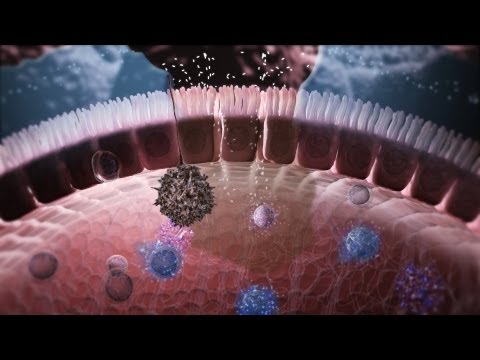
.jpg)
The gut microbiota has an essential role in stimulating the development and maintainance of the intestinal immune system – in fact, without the gut microbiome the human body would be unable to protect its health from being affected by all environmental pathogens that enter the body, e.g. through our daily food. The cellular and molecular mechanisms by which this is achieved are nicely illustrated in a video animation that Nature Immunology has released with the expertise of world-reknown immunologist Tom MacDonald from London:
Antigenic Shift

Antigenic shift is the process by which two or more different strains of a virus, or strains of two or more different viruses, combine to form a new subtype having a mixture of the surface antigens of the two or more original strains. The term is often applied specifically to influenza, as that is the best-known example, but the process is also known to occur with other viruses, such as visna virus in sheep.[1] Antigenic shift is a specific case of reassortment or viral shift that confers a phenotypic change.

Vaccines Animation

Vaccines is a biological preparation that improves immunity to a particular disease. A vaccine typically contains a small amount of an agent that resembles a microorganism. The agent stimulates the body's immune system to recognize the agent as foreign, destroy it, and "remember" it, so that the immune system can more easily recognize and destroy any of these microorganisms that it later encounters.
Vaccines can be prophylactic (e.g. to prevent or ameliorate the effects of a future infection by any natural or "wild" pathogen), or therapeutic (e.g. vaccines against cancer are also being investigated; see cancer vaccine).

Types
Vaccines are dead or inactivated organisms or purified products derived from them.
There are several types of vaccines currently in use.These represent different strategies used to try to reduce risk of illness, while retaining the ability to induce a beneficial immune response.
Killed
Vaccines containing killed microorganisms - these are previously virulent micro-organisms which have been killed with chemicals or heat. Examples are vaccines against flu, cholera, bubonic plague, polio and hepatitis A.
Attenuated
Some vaccines contain live, attenuated virus microorganisms. These are live micro-organisms that have been cultivated under conditions that disable their virulent properties, or which use closely-related but less dangerous organisms to produce a broad immune response. They typically provoke more durable immunological responses and are the preferred type for healthy adults. Examples include yellow fever, measles, rubella, and mumps. The live Mycobacterium tuberculosis vaccine developed by Calmette and Guérin is not made of a contagious strain, but contains a virulently modified strain called "BCG" used to elicit immunogenicity to the vaccine.
Toxoid
Toxoids - these are inactivated toxic compounds in cases where these (rather than the micro-organism itself) cause illness. Examples of toxoid-based vaccines include tetanus and diphtheria. Not all toxoids are for micro-organisms; for example, Crotalus atrox toxoid is used to vaccinate dogs against rattlesnake bites.
Subunit
Protein subunit - rather than introducing an inactivated or attenuated micro-organism to an immune system (which would constitute a "whole-agent" vaccine), a fragment of it can create an immune response. Characteristic examples include the subunit vaccine against Hepatitis B virus that is composed of only the surface proteins of the virus (produced in yeast) and the virus-like particle (VLP) vaccine against human papillomavirus (HPV) that is composed of the viral major capsid protein.
Conjugate
Conjugate - certain bacteria have polysaccharide outer coats that are poorly immunogenic. By linking these outer coats to proteins (e.g. toxins), the immune system can be led to recognize the polysaccharide as if it were a protein antigen. This approach is used in the Haemophilus influenzae type B vaccine.
Experimental
A number of innovative vaccines are also in development and in use:
* Recombinant Vector - by combining the physiology of one micro-organism and the DNA of the other, immunity can be created against diseases that have complex infection processes
* DNA vaccination - in recent years a new type of vaccine called DNA vaccination, created from an infectious agent's DNA, has been developed. It works by insertion (and expression, triggering immune system recognition) of viral or bacterial DNA into human or animal cells. Some cells of the immune system that recognize the proteins expressed will mount an attack against these proteins and cells expressing them. Because these cells live for a very long time, if the pathogen that normally expresses these proteins is encountered at a later time, they will be attacked instantly by the immune system. One advantage of DNA vaccines is that they are very easy to produce and store. As of 2006, DNA vaccination is still experimental.
* T-cell receptor peptide vaccines are under development for several diseases using models of Valley Fever, stomatitis, and atopic dermatitis. These peptides have been shown to modulate cytokine production and improve cell mediated immunity.
* Targeting of identified bacterial proteins that are involved in complement inhibition would neutralize the key bacterial virulence mechanism.
While most vaccines are created using inactivated or attenuated compounds from micro-organisms, synthetic vaccines are composed mainly or wholly of synthetic peptides, carbohydrates or antigens.
Valence
Vaccines may be monovalent (also called univalent) or multivalent (also called polyvalent). A monovalent vaccine is designed to immunize against a single antigen or single microorganism. A multivalent or polyvalent vaccine is designed to immunize against two or more strains of the same microorganism, or against two or more microorganisms. In certain cases a monovalent vaccine may be preferable for rapidly developing a strong immune response.
Vaccine. (2009, November 8). In Wikipedia, The Free Encyclopedia. Retrieved 07:59, November 9, 2009, from http://en.wikipedia.org/w/index.php?title=Vaccine&oldid=324652602
Allergy

Allergy is a disorder of the immune system that is often called atopy. Allergic reactions occur to environmental substances known as allergens; these reactions are acquired, predictable and rapid. Strictly, allergy is one of four forms of hypersensitivity and is called type I (or immediate) hypersensitivity. It is characterized by excessive activation of certain white blood cells called mast cells and basophils by a type of antibody, known as IgE, resulting in an extreme inflammatory response. Common allergic reactions include eczema, hives, hay fever, asthma, food allergies, and reactions to the venom of stinging insects such as wasps and bees.

Mild allergies like hay fever, are highly prevalent in the human population and cause symptoms such as allergic conjunctivitis and runny nose. Similarly, conditions such as asthma are common, in which allergy plays a major role. In some people, severe allergies to environmental or dietary allergens, or to medication, occur that may result in life-threatening anaphylactic reactions and potentially death.
A variety of tests now exist to diagnose allergic conditions; these include testing the skin for responses to known allergens or analyzing the blood for the presence and levels of allergen-specific IgE. Treatments for allergies include allergen avoidance, use of antihistamines, steroids or other oral medications, immunotherapy to desensitize the response to allergen, and targeted therapy.
Classification and history
The concept "allergy" was originally introduced in 1906 by the Viennese pediatrician Clemens von Pirquet, after noting that some of his patients were hypersensitive to normally innocuous entities such as dust, pollen, or certain foods. Pirquet called this phenomenon "allergy" from the Greek words allos meaning "other" and ergon meaning "work".Historically, all forms of hypersensitivity were classified as allergies, and all were thought to be caused by an improper activation of the immune system. Later, it became clear that several different disease mechanisms were implicated, with the common link to a disordered activation of the immune system. In 1963, a new classification scheme was designed by Philip Gell and Robin Coombs that described four types of hypersensitivity reactions, known as Type I to Type IV hypersensitivity. With this new classification, the word "allergy" was restricted to only type I hypersensitivities (also called immediate hypersensitivity), which are characterized as rapidly developing reactions.
A major breakthrough in understanding the mechanisms of allergy was the discovery of the antibody class labeled immunoglobulin E (IgE) - Kimishige Ishizaka and co-workers were the first to isolate and describe IgE in the 1960s.
Signs and symptoms
Many allergens are airborne particles, such as dust or pollen. Allergic rhinitis, also known as hay fever, occurs in response to airborne pollen, and causes irritation of the nose, sneezing, and itching and redness of the eyes. Inhaled allergens can also lead to asthmatic symptoms, caused by narrowing of the airways (bronchoconstriction) and increased production of mucus in the lungs, shortness of breath (dyspnea), coughing and wheezing.
Aside from these ambient allergens, allergic reactions can result from foods, insect stings, and reactions to medications like aspirin, and antibiotics such as penicillin. Symptoms of food allergy include abdominal pain, bloating, vomiting, diarrhoea, itchy skin, and swelling of the skin during hives or angiooedema. Food allergies rarely cause respiratory (asthmatic) reactions, or rhinitis. Insect stings, antibiotics and certain medicines produce a systemic allergic response that is also called anaphylaxis; multiple systems can be affected including the digestive system, the respiratory system, and the circulatory system. Depending of the rate of severity, it can cause cutaneous reactions, bronchoconstriction, edema, hypotension, coma and even death. This type of reaction can be triggered suddenly or the onset can be delayed. The severity of this type of allergic response often requires injections of epinephrine, sometimes through a device known as the Epi-Pen auto-injector. The nature of anaphylaxis is such that the reaction can seemingly be subsiding, but may recur throughout a prolonged period of time.
Substances that come into contact with the skin, such as latex are also common causes of allergic reactions, known as contact dermatitis or eczema. Skin allergies frequently cause rashes, or swelling and inflammation within the skin, in what is known as a "wheal and flare" reaction characteristic of hives and angioedema.
Cause
Risk factors for allergy can be placed in two general categories, namely host and environmental factors. Host factors include heredity, sex, race and age, with heredity being by far the most important. There are recent increases in the incidence of allergic disorders, however, that cannot be explained by genetic factors alone. The four main candidate environmental factors are alterations in exposure to infectious diseases during early childhood, environmental pollution, allergen levels, and dietary changes.
Genetic basis
Allergic diseases are strongly familial: identical twins are likely to have the same allergic diseases about 70% of the time; the same allergy occurs about 40% of the time in non-identical twins. Allergic parents are more likely to have allergic children, and their allergies are likely to be stronger than those from non-allergic parents. However some allergies are not consistent along genealogies; parents who are allergic to peanuts, may have children who are allergic to ragweed, or siblings that are allergic to different things. It seems that the likelihood of developing allergies is inherited and due to some irregularity in the way the immune system works, but the specific allergen, which causes the development of an allergy,
The risk of allergic sensitization and the development of allergies varies with age, with young children most at risk. Several studies have shown that IgE levels are highest in childhood and fall rapidly between the ages of 10 and 30 years. The peak prevalence of hay fever is highest in children and young adults and the incidence of asthma is highest in children under 10. Overall, boys have a higher risk of developing allergy than girls, although for some diseases, namely asthma in young adults, females are more likely to be affected. Sex differences tend to decrease in adulthood. Ethnicity may play a role in some allergies, however racial factors have been difficult to separate from environmental influences and changes due to migration. Interestingly, with regards to asthma, it has been suggested that different genetic loci are responsible for asthma in people of Caucasian, Hispanic, Asian, and African origins.
Environmental factors
International differences have been associated with the number of individuals within a population that suffer from allergy. Allergic diseases are more common in industrialized countries than in countries that are more traditional or agricultural, and there is a higher rate of allergic disease in urban populations versus rural populations, although these differences are becoming less defined.
Exposure to allergens, especially in early life, is an important risk factor for allergy. Alterations in exposure to microorganisms is the most plausible explanation, at present, for the increase in atopic allergy. Since children that live in large families or overcrowded households, or attend day care, have a reduced incidence of allergic disease, a relationship has been proposed between exposures to bacteria and viruses during childhood, and protection against the development of allergy, which has been called – the "hygiene hypothesis". Exposure to endotoxin and other components of bacteria may reduce atopic diseases.Endotoxin exposure reduces release of inflammatory cytokines such as TNF-α, IFNγ, interleukin-10, and interleukin-12 from white blood cells (leukocytes) that circulate in the blood. Certain microbe-sensing proteins, known as Toll-like receptors, found on the surface of cells in the body are also thought to be involved in these processes.
Gutworms and similar parasites are present in untreated drinking water in developing countries, and were present in the water of developed countries until the routine chlorination and purification of drinking water supplies. Recent research has shown that some common parasites, such as intestinal worms (e.g. hookworms), secrete chemicals into the gut wall (and hence the bloodstream) that suppress the immune system and prevent the body from attacking the parasite.This gives rise to a new slant on the hygiene hypothesis theory — that co-evolution of man and parasites has led to an immune system that only functions correctly in the presence of the parasites. Without them, the immune system becomes unbalanced and oversensitive. In particular, research suggests that allergies may coincide with the delayed establishment of gut flora in infants. However, the research to support this theory is conflicting, with some studies performed in China and Ethiopia showing an increase in allergy in people infected with intestinal worms. Clinical trials have been initiated to test the effectiveness of certain worms in treating some allergies. It may be that the term 'parasite' could turn out to be inappropriate, and in fact a hitherto unsuspected symbiosis is at work


