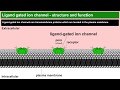
Ligand-gated ion channels (LGICs) are a group of transmembrane ion channel proteins which open to allow ions such as Na+, K+, Ca2+, or Cl- to pass through the membrane in response to the binding of a chemical messenger (i.e. a ligand),such as a neurotransmitter.
Showing posts with label Pharmacology. Show all posts
Ligand gated ion channels structure and function

Gleevecs Effects on tryosine Kinase
Imatinib is a drug used to treat certain types of cancer. It is currently marketed by Novartis as Gleevec (USA) or Glivec (Europe/Australia) as its mesylate salt, imatinib mesilate (INN). It was originally coded during development as CGP57148B or STI-571 (these terms are used in early preclinical publications). It is used in treating chronic myelogenous leukemia (CML), gastrointestinal stromal tumors (GISTs) and a number of other malignancies.
The animation begins by introducing the Philadelphia Chromosome, the result of a reciprocal translocation between chromosomes 9 and 22. More specifically the breakpoint cluster region (BCR) of chromosome 22 is fused with part of the Abelson (ABL) gene on chromosome 9. The resulting BCR-ABL genetic domain now located within chromosome 22 and codes for a mutant tyrosine kinase also known as BCR-ABL. Under normal circumstances tyrosine kinase proteins respond to external cellular messaging proteins, and ultimately initiate a series of reactions that culminate in cellular replication.
Conversely, BCR-ABL is constitutively active, meaning it does not require activation by the aforementioned cellular messaging proteins in order to stimulate cellular replication. This results in acceleration of cell division, an inhibition of DNA repair, overall genomic instability, and the fatal blast crisis characteristic of chronic myelogenous leukemia. The animation progresses to introduce Gleevec (imatinib), the first in a class of drugs that specifically target and competively inhibit the ATP binding site on BCR-ABL tyrosine kinase. This prevents the ABL domain from phosphorylating the tyrosine residue, and as a result preventing the proliferation of hematopoietic cells that express BCR-ABL. Therapy with imatinib results in a dramatic reduction of tumor clone cells and the occurrence of blast crisis', through targeted drug treatment which leaves health cells unscathed.
Drugs : One Size Does Not Fit All -Lecture
There are a number of causes for variation in drug response across the population, but differences in genetics are an important factor. Russ Altman, Professor & Chair of Bioengineering and Professor of Genetics and Medicine, discusses how variations in genetics can alter the "typical" response as well as touch upon the ethical issues with the use of this knowledge.Russ Altman for the Stanford University
Russ Altman started his education in Harvard university his work was primary in biochemistry and molecular biology,he came to Stanford and received his phd in Medical Information Science and MD in Stanford medical school
He was the president of International Society for Computational Biology (2000-2001) ,In Stanford he is professor of Genetics ,Bioengineering ,Medicine and computer science and He is the chairman of Bioengineering department.
In this lecture Dr.Russ Altman speaks about variation drug response,Human genome ,Pharmacology
This lecture will very useful for those who are interested in Drug designing,Bioinformatics students.
ClinSeq: A Large-Scale Medical Sequencing Clinical Research Pilot Study
The purpose of ClinSeq is to pilot large-scale medical sequencing (LSMS) in a clinical research setting. By sequencing targeted regions of a person's genome and returning relevant and individual results to that person, we will begin investigating some of the technical, medical and genetic counseling issues that accompany the implementation of LSMS in the clinical setting.
Specifically, we seek to develop the technologic and procedural infrastructure to facilitate this type of research and demonstrate that it is feasible to sequence and interpret large amounts of genomic sequence data and return individual results to subjects.
Reducing Chemotherapy Toxicity for Colon Cancer Patients
Everyone responds differently to medicines. The dose of a drug that cures one person can be ineffective-or even toxic-in someone else. Although many non-genetic factors play a role in how an individual patient responds to a particular drug treatment, many differences in drug response come from genetic variation. Individualizing a drug's dose based on pharmacogenomic information can help a patient get the most benefit from a drug while minimizing side effects.
Take the example of treating colorectal cancer with a chemotherapy regimen that includes Camptosar (irinotecan). A gene, called UGT1A1, produces an enzyme that metabolizes Camptosar. Variations in this gene can influence a patient's ability to break down the drug.
About 10 percent of the North American population has a variation of the UGT1A1 gene that reduces their ability to metabolize Camptosar, leading to high blood levels of the drug and a higher risk of toxic side effects. If these patients are given standard doses of Camptosar, about half will develop severe neutropenia, which can be fatal.
A test, called the Invader UGT1A1 Molecular Assay, can identify whether a patient has the genetic variant affecting the metabolism of Camptosar and thus would be at higher risk for developing severe neutropenia. The drug label says to consider lowering the starting dose of the Camptosar for those patients found to be high risk.
Subscribe to:
Posts (Atom)