Pages

Showing posts with label disorder. Show all posts

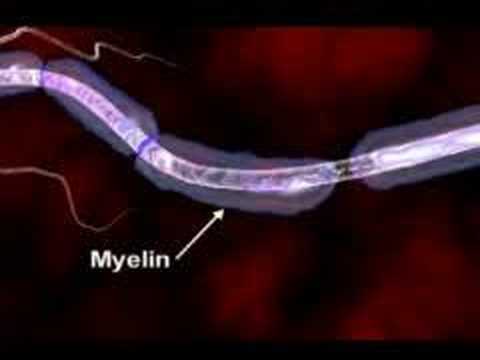
Multiple Sclerosis Animation

Multiple sclerosis (abbreviated MS, also known as disseminated sclerosis or encephalomyelitis disseminata) is an autoimmune condition in which the immune system attacks the central nervous system, leading to demyelination. Disease onset usually occurs in young adults, and it is more common in women. It has a prevalence that ranges between 2 and 150 per 100,000. MS was first described in 1868 by Jean-Martin Charcot.
MS affects the ability of nerve cells in the brain and spinal cord to communicate with each other. Nerve cells communicate by sending electrical signals called action potentials down long fibers called axons, which are wrapped in an insulating substance called myelin. In MS, the body's own immune system attacks and damages the myelin. When myelin is lost, the axons can no longer effectively conduct signals. The name multiple sclerosis refers to scars (scleroses – better known as plaques or lesions) in the white matter of the brain and spinal cord, which is mainly composed of myelin.Although much is known about the mechanisms involved in the disease process, the cause remains unknown. Theories include genetics or infections. Different environmental risk factors have also been found.

  Subscribe in a reader


Multiple sclerosis (MS) is a disease that affects the central nervous system. the CNS which consist of the brain spinal cord optic nerves everything we do whether it's taking a step to solving a problem or simply breathing relies on the proper functioning of the CNS.To understand how MS may impact the CNS we must explore the disease at the cellular level .In the brain millions of nerve cells called neurons continually send and receive signals, each signal is a minute but necessary part of the intricate CNS orchestrations that culminate in the actions, sensations, thoughts and emotions that comprised the human experience.Normally the path over which a nerve signal travels is protected by a type of insulation called the myelin sheath,this insulation is essential for nerve signals to reach their target.In MS the myelin sheath is eroded and the underlying wire like nerve fiber is also damaged, this leads to a breakdown in the ability of the nerve cells transmit signals. it is believed that the loss of myelin is the result of mistaken attack of immune cells.Immune cells protect the body against foreign substances such as bacteria and viruses .But in MS something goes awry.Immune cells infiltrate the brain and spinal cord seek and attack.As ongoing inflammation and tissue damage occurs nerve signals are disrupted. this causes unpredictable symptoms that can range from numbness or tingling to blindness and paralysis.These losses may be temporary or permanent

Progeria syndrome

Hutchinson-Gilford progeria syndrome is a genetic condition characterized by the dramatic, rapid appearance of aging beginning in childhood. Affected children typically look normal at birth and in early infancy, but then grow more slowly than other children and do not gain weight at the expected rate (failure to thrive). They develop a characteristic facial appearance including prominent eyes, a thin nose with a beaked tip, thin lips, a small chin, and protruding ears. Hutchinson-Gilford progeria syndrome also causes hair loss (alopecia), aged-looking skin, joint abnormalities, and a loss of fat under the skin (subcutaneous fat). This condition does not disrupt intellectual development or the development of motor skills such as sitting, standing, and walking.


  Subscribe in a reader


Hutchinson-Gilford Progeria syndrome is an extremely rare condition in which physical aspects of aging are greatly accelerated, and few affected children live past age 13. About 1 in 8 million babies are born with this condition. It is a genetic condition, but occurs sporadically and is usually not inherited in families.progeria syndrome is considered an autosomal dominant condition, which means one copy of the altered gene in each cell is sufficient to cause the disorder. The condition results from new mutations in the LMNA gene, and almost always occurs in people with no history of the disorder in their family.
Causes
Mutaion is LMNA gene causes Progeria syndrome,LMNA is a gene which povides instruction to make a parotein called Lamin A,Lamin A protein plays important role in determining the shape of the nuclues within cells,It si essential component for nuclear envelope,Mutationsin this gene causes abnormal version of lamin A protein,This altered protein makes teh nuclear envelope unstable and progressively damages the nuclues,making cells more likely to die Prematurely.

Epilepsy

Epilepsy is a common chronic neurological disorder that is characterized by recurrent unprovoked seizures.These seizures are transient signs and/or symptoms due to abnormal, excessive or synchronous neuronal activity in the brain. About 50 million people worldwide have epilepsy at any one time.Epilepsy should not be understood as a single disorder, but rather as a group of syndromes with vastly divergent symptoms but all involving episodic abnormal electrical activity in the brain.

  Subscribe in a reader


Epilepsies are classified in six ways:
  1. By their first cause (or etiology).
  2. By the observable manifestations of the seizures, known as semiology.
  3. By the location in the brain where the seizures originate.
  4. As a part of discrete, identifiable medical syndromes.
  5. By the event that triggers the seizures, as in primary reading epilepsy or musicogenic epilepsy.
In 1981, the International League Against Epilepsy (ILAE) proposed a classification scheme for individual seizures that remains in common use. This classification is based on observation (clinical and EEG) rather than the underlying pathophysiology or anatomy and is outlined later on in this article. In 1989, the ILAE proposed a classification scheme for epilepsies and epileptic syndromes. This can be broadly described as a two-axis scheme having the cause on one axis and the extent of localisation within the brain on the other. Since 1997, the ILAE have been working on a new scheme that has five axes: ictal phenomenon, seizure type, syndrome, etiology and impairment.
When the neuron becomes excited it passes an electrical signal along its thin biological wire called an axon for communicating with other neurons in the brain. Other neurons either can be excited or inhibited by the signal. When too many neurons become excited all at once then a seizure can result. So seizure is like an electrical storm in the brain. During this abnormal electrical storm the involved parts of the brain cannot perform their normal tasks and people experienced sudden alterations in movements, sensations, awareness or behavior. a seizure typically goes on for few seconds to a few minutes .the end of the seizure is a transition back to individuals normal state .because the word ictal is Latin for seizure the recovery period is referred to as the post-ictal. Which can last from seconds to hours person's level of awareness gradually improves during the post. Ictal period.

Homocystinuria

Homocystinuria, also known as Cystathionine beta synthase deficiency which occurs 1 in 200000 to 335000 people world wide,It is an inherited disorder of the metabolism of the amino acid methionine, often involving cystathionine beta synthase.This form of homocystinuria is characterized by dislocation of the lens in the eye, an increased risk of abnormal blood clots, and skeletal abnormalities. It is an inherited autosomal recessive trait, which means a child needs to inherit the defective gene from both parents to be affected.


  Subscribe in a reader Homocystinuria is caused by mutations in CBS MTHFR MTR,and MTRR genes
The CBS gene provides instructions for producing cystathionine beta-synthase. This enzyme is responsible for one step in a chemical pathway that processes the amino acid methionine. Other amino acids, including homocysteine, are also products of this pathway. Mutations in the CBS gene disrupt the function of cystathionine beta-synthase, preventing homocysteine from being used properly. As a result, this amino acid and other potentially toxic substances build up in the blood, and some of the excess homocysteine is excreted in urine.